
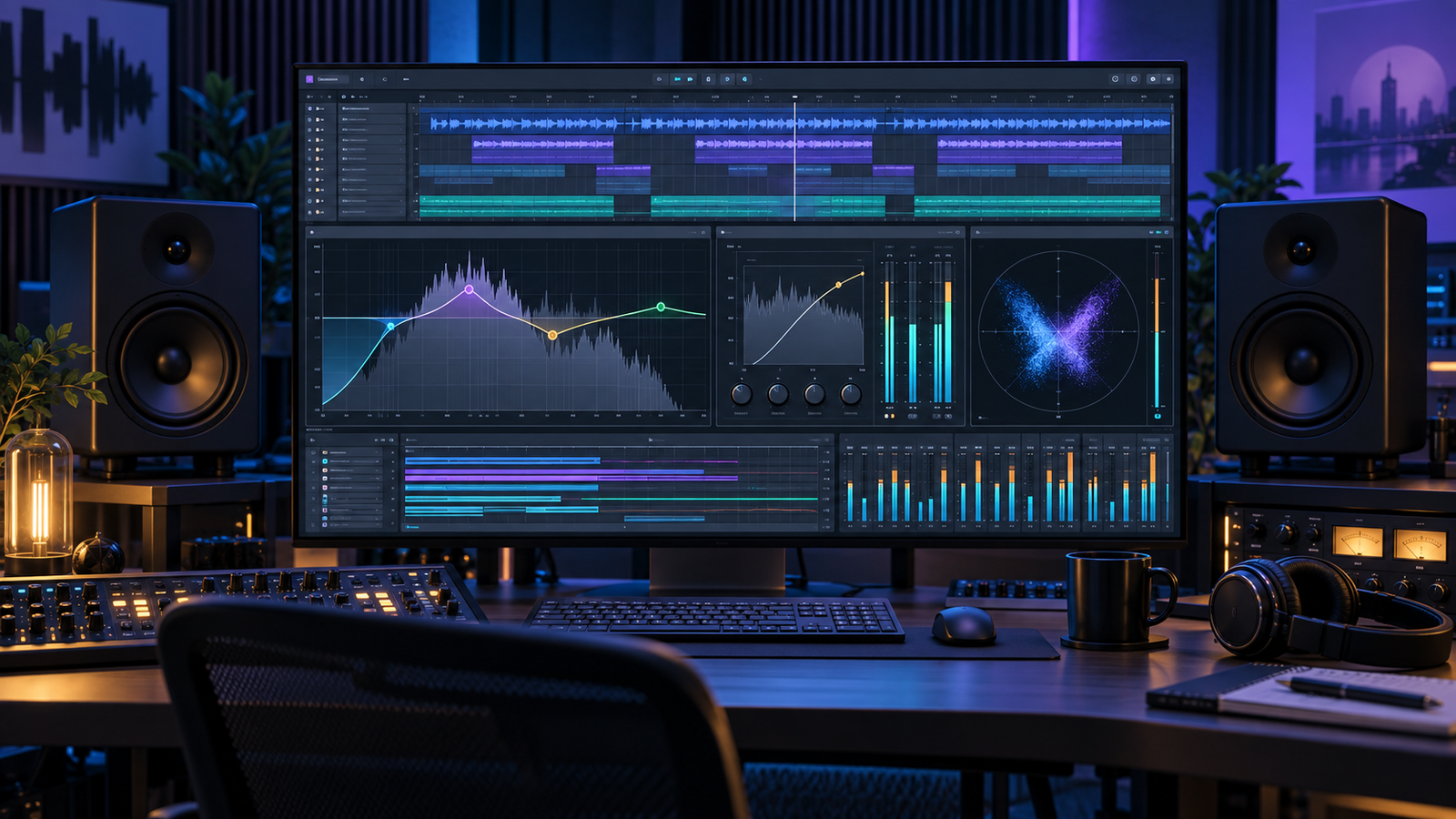
A frequency chart can help you diagnose a crowded mix, but it cannot assign every sound a permanent private slot. Great drum & bass mixes contain overlap. They remain clear because the producer decides which element leads in each range, controls unnecessary energy and checks every decision in context.
This guide gives you practical starting ranges for the main elements in drum & bass. Use them as listening zones, not rigid EQ instructions. The exact fundamental of a kick, sub or musical note changes from track to track, and a sound that looks busy on an analyser may still work perfectly.
The frequency spectrum in plain English
- 20–40 Hz: infra-sub. More felt than heard on large systems. Difficult for small speakers and easy to overuse.
- 40–80 Hz: main sub range. The weight of the bass and often part of the kick fundamental.
- 80–200 Hz: upper bass and low body. Bass harmonics, kick weight, snare body and the warmth of many instruments meet here.
- 200–500 Hz: low mids. Body and thickness live here, but excessive buildup can make a mix cloudy or boxy.
- 500 Hz–2 kHz: midrange identity. Bass character, snare tone, vocals, synths and many recognisable details.
- 2–6 kHz: presence and attack. Drum transients, vocal intelligibility and aggressive bass harmonics. Too much becomes tiring.
- 6–12 kHz: brightness. Hats, cymbals, snare air and the top of distorted sounds.
- 12–20 kHz: air. A sense of openness, though many listeners and playback systems reproduce less of this range.
Screenshot to add: FabFilter Pro-Q 3 on the master while a full drop plays. Label the broad zones above; do not show corrective EQ yet.
Sub bass: approximately 35–80 Hz
The sub usually owns the deepest stable energy. In many DnB tracks the useful fundamental sits around 40–65 Hz, depending on the key and notes. Remove inaudible rumble below the musical content only when it is genuinely present; an automatic steep cut at 30 Hz is not always harmless because filters can change phase and peak level.
Keep the lowest part focused and usually mono. Judge the sub against the kick, not in solo. If both peak strongly at the same frequency and time, decide which one provides the deepest weight. You might shorten the kick, change its tuning, adjust the bass envelope or use gentle dynamic control rather than carving a huge permanent hole.
Kick: roughly 45–120 Hz plus attack
A kick may have a low fundamental between about 45 and 90 Hz, body around 90–180 Hz and a click or attack between 2 and 5 kHz. Not every kick needs all three. A short, higher-tuned kick can leave room for sustained sub; a deeper kick may become part of the low-end statement and require more space from the bass.
Snare: body, crack and air
The snare body often speaks around 150–250 Hz, its recognisable tone may sit from 400 Hz to 1.5 kHz, and the crack commonly appears between 2 and 6 kHz. Bright layers can extend above 8 kHz. Layer by function: one sound for weight, one for attack and perhaps one for texture. If two layers perform the same job, they may soften each other through phase cancellation.
Breaks and percussion
Breakbeats can cover almost the whole spectrum. Decide whether a break supplies body, shuffle, ghost notes or top texture. If the programmed kick and snare already own the low impact, high-pass or reduce the break’s low end until it supports rather than competes. The correct cutoff might be 80 Hz, 150 Hz or higher depending on the sample and its role.
Hi-hats and shakers often live mainly above 5 kHz, but their lower resonances can still clutter the upper mids. Listen for harshness around 3–8 kHz before boosting “air.” Several individually pleasant bright sounds can combine into an exhausting mix.
Mid bass: approximately 90 Hz to several kilohertz
Mid bass gives the low end an audible identity on phones, laptops and smaller speakers. It may begin around 90–150 Hz and extend well above 2 kHz. The important question is where it stops duplicating the sub and starts providing character. High-pass the mid layer only as much as required, then compare the combined bass with the untreated sound. A crossover that is too high can disconnect the weight from the character; too low can create unstable peaks.
Vocals, leads, pads and effects
Vocals often need intelligibility between 1 and 5 kHz, but their body may extend down toward 100–250 Hz. High-pass according to the performance rather than using a preset value. Leads frequently compete with bass harmonics in the mids. Pads and atmospheres can occupy huge ranges, so remove low energy that contributes no musical value and automate space when the arrangement becomes dense.
Risers, impacts and noise are easy to underestimate because they are temporary. Check them inside transitions. A cinematic impact with a large sub tail can steal the first beat of a drop even if it sounds impressive alone.
Screenshot to add: Pro-Q 3 instances on kick, snare, break, sub and mid bass. Show only purposeful filters and annotate the reason for each move.
Frequency masking: when two sounds hide each other
Masking happens when similar energy occurs at a similar time and one element makes another harder to perceive. EQ can help, but first try the higher-level decisions: change the sound, octave, note, rhythm, envelope, level or arrangement. Two elements separated in time can share the same frequency range without conflict.
- Choose the priority. Decide which element should be noticed first in the conflicting range.
- Adjust level. A 1 dB change may solve more than a dramatic EQ curve.
- Check timing and envelope. Shorten tails or move notes before applying heavy processing.
- Use broad EQ where possible. Small tonal moves often sound more natural than many narrow notches.
- Use dynamic EQ only when the conflict is dynamic. Let the range move when the competing element plays rather than thinning it permanently.
A repeatable Pro-Q 3 workflow
- Play the busiest part of the drop at a moderate monitoring level.
- Open the analyser but make your first description with your ears: muddy, harsh, hidden, thin or uncontrolled.
- Mute one suspected element. If the problem disappears, investigate its level and role before EQ.
- Use a temporary bell boost to locate a resonance, then return the gain to zero and apply the smallest useful reduction.
- Bypass the plug-in and level-match. Keep the change only if the complete mix communicates more clearly.
Common beginner mistakes
- High-passing every sound automatically and removing useful body.
- Soloing for too long and creating tones that do not fit the drop.
- Boosting the same “presence” range on every important element.
- Watching the analyser instead of deciding what should lead.
- Trying to solve an arrangement problem with narrow EQ cuts.
- Adding high-frequency brightness when the real problem is excessive low-mid energy.
Your goal is not an empty spectrum with perfectly separated shapes. It is a controlled hierarchy: the sub supplies weight, the drums define impact and groove, the midrange communicates musical identity, and the top end adds movement without fatigue. Continue with the guide to mixing lessons or explore the beginner pathway.