
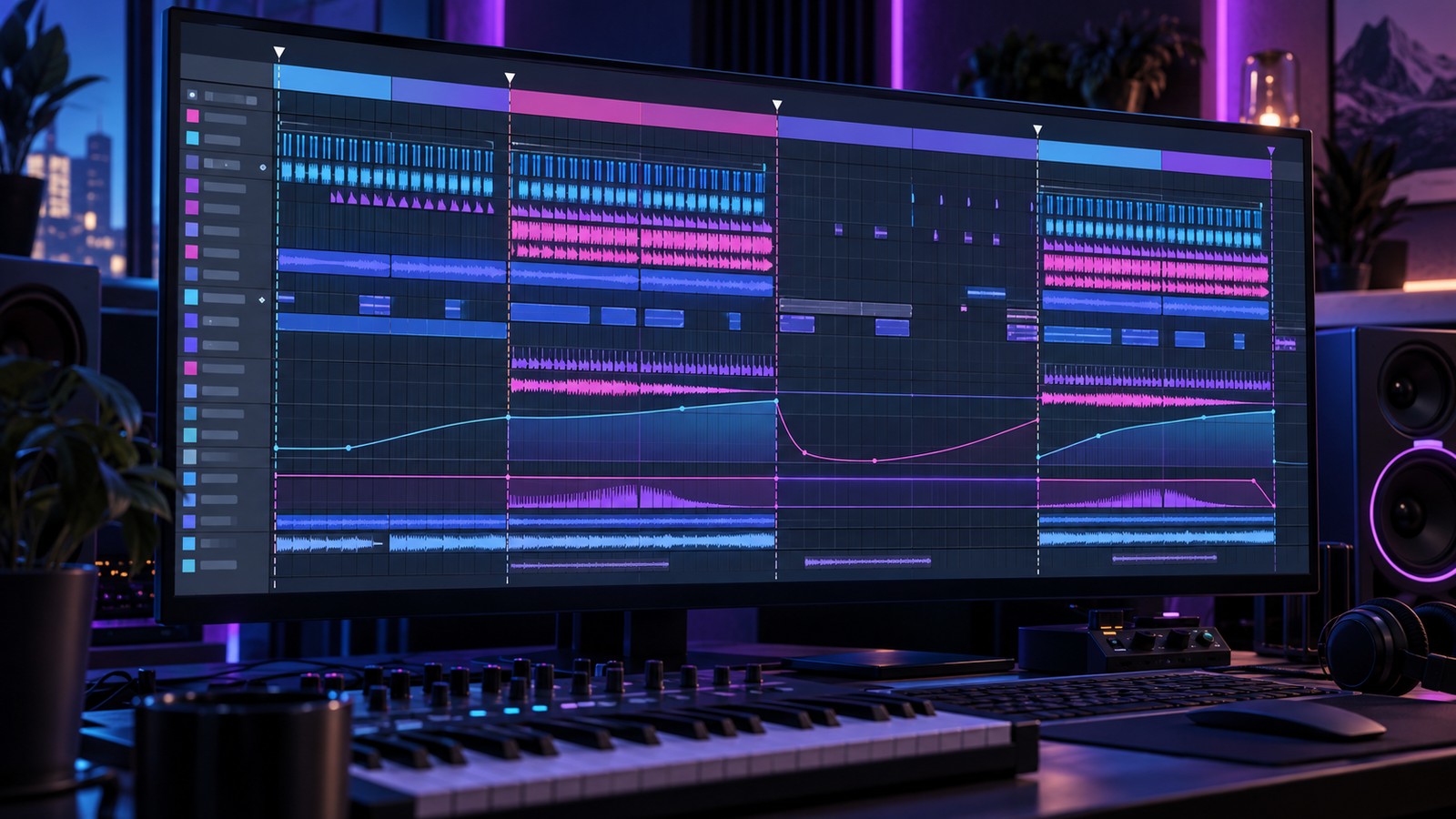
Beatmatching keeps tracks in time; EQ decides which parts dominate. Learn controlled bass exchanges and clearer layered drops.
This guide is for producers and DJs who want to control low, mid and high frequencies during blends, bass exchanges and double drops without overloading the mixer.
The aim is not to provide a rigid recipe. Drum-and-bass records vary widely in subgenre, arrangement and sound palette, so the useful skill is learning how to identify a problem, test a change and retain only what improves the music.
Learn the mixer’s EQ behaviour
Learn the mixer’s EQ behaviour is a practical stage in how to use eq for drum & bass dj transitions and double drops. Begin with the simplest version of the material and decide what the listener needs to perceive: timing, weight, clarity, movement, contrast or reliable delivery.
Solo can reveal faults, but context decides whether a sound is successful. Reintroduce the kick, snare, bass and main musical element before committing the setting.
A useful working method is to create a short comparison. Keep one version unchanged, make a deliberate adjustment related to learn the mixer’s eq behaviour, and switch between them at matched loudness. Write down the audible difference before looking at numerical settings. This prevents the display or a louder output from deciding for you.
Check the decision against the main kick and snare, the sub foundation and the busiest section of the arrangement. If the change helps only in isolation, reduce it or reconsider the source. The strongest result usually leaves a clear role for every important element rather than making every layer equally large.
Match channel gain first
Match channel gain first is a practical stage in how to use eq for drum & bass dj transitions and double drops. Begin with the simplest version of the material and decide what the listener needs to perceive: timing, weight, clarity, movement, contrast or reliable delivery.
Use meters and analysers to confirm what you hear, not to replace listening. A visually tidy result can still be rhythmically or tonally wrong.
A useful working method is to create a short comparison. Keep one version unchanged, make a deliberate adjustment related to match channel gain first, and switch between them at matched loudness. Write down the audible difference before looking at numerical settings. This prevents the display or a louder output from deciding for you.
Check the decision against the main kick and snare, the sub foundation and the busiest section of the arrangement. If the change helps only in isolation, reduce it or reconsider the source. The strongest result usually leaves a clear role for every important element rather than making every layer equally large.
Practise a simple bass exchange
Practise a simple bass exchange is a practical stage in how to use eq for drum & bass dj transitions and double drops. Begin with the simplest version of the material and decide what the listener needs to perceive: timing, weight, clarity, movement, contrast or reliable delivery.
Preserve an editable version before destructive changes. Naming the source and processed result clearly makes comparison and later revision much easier.
A useful working method is to create a short comparison. Keep one version unchanged, make a deliberate adjustment related to practise a simple bass exchange, and switch between them at matched loudness. Write down the audible difference before looking at numerical settings. This prevents the display or a louder output from deciding for you.
[SCREENSHOT PLACEHOLDER — Ableton Live or DJ software: two-track transition showing low-frequency ownership and aligned phrase markers]
Check the decision against the main kick and snare, the sub foundation and the busiest section of the arrangement. If the change helps only in isolation, reduce it or reconsider the source. The strongest result usually leaves a clear role for every important element rather than making every layer equally large.
Control midrange and vocals
Control midrange and vocals is a practical stage in how to use eq for drum & bass dj transitions and double drops. Begin with the simplest version of the material and decide what the listener needs to perceive: timing, weight, clarity, movement, contrast or reliable delivery.
Avoid solving several unrelated issues with one extreme processor. Source choice, arrangement, level, timing and automation often provide cleaner corrections.
A useful working method is to create a short comparison. Keep one version unchanged, make a deliberate adjustment related to control midrange and vocals, and switch between them at matched loudness. Write down the audible difference before looking at numerical settings. This prevents the display or a louder output from deciding for you.
Check the decision against the main kick and snare, the sub foundation and the busiest section of the arrangement. If the change helps only in isolation, reduce it or reconsider the source. The strongest result usually leaves a clear role for every important element rather than making every layer equally large.
Manage snares and cymbal buildup
Manage snares and cymbal buildup is a practical stage in how to use eq for drum & bass dj transitions and double drops. Begin with the simplest version of the material and decide what the listener needs to perceive: timing, weight, clarity, movement, contrast or reliable delivery.
Check the loudest and most exposed sections. A decision that works in a breakdown may react very differently when the complete drop reaches the same bus or master chain.
A useful working method is to create a short comparison. Keep one version unchanged, make a deliberate adjustment related to manage snares and cymbal buildup, and switch between them at matched loudness. Write down the audible difference before looking at numerical settings. This prevents the display or a louder output from deciding for you.
Check the decision against the main kick and snare, the sub foundation and the busiest section of the arrangement. If the change helps only in isolation, reduce it or reconsider the source. The strongest result usually leaves a clear role for every important element rather than making every layer equally large.
Use filters with headroom
Use filters with headroom is a practical stage in how to use eq for drum & bass dj transitions and double drops. Begin with the simplest version of the material and decide what the listener needs to perceive: timing, weight, clarity, movement, contrast or reliable delivery.
Finish with a bypassed, level-matched comparison and a mono check where relevant. Keep the change only when its benefit survives those tests.
A useful working method is to create a short comparison. Keep one version unchanged, make a deliberate adjustment related to use filters with headroom, and switch between them at matched loudness. Write down the audible difference before looking at numerical settings. This prevents the display or a louder output from deciding for you.
[SCREENSHOT PLACEHOLDER — Ableton Live or DJ software: before-and-after comparison for use filters with headroom with the relevant controls labelled]
Check the decision against the main kick and snare, the sub foundation and the busiest section of the arrangement. If the change helps only in isolation, reduce it or reconsider the source. The strongest result usually leaves a clear role for every important element rather than making every layer equally large.
Assign roles in double drops
Assign roles in double drops is a practical stage in how to use eq for drum & bass dj transitions and double drops. Begin with the simplest version of the material and decide what the listener needs to perceive: timing, weight, clarity, movement, contrast or reliable delivery.
Work from the musical problem rather than a favourite preset. Make one change, level-match it where possible and judge the result in the full arrangement.
A useful working method is to create a short comparison. Keep one version unchanged, make a deliberate adjustment related to assign roles in double drops, and switch between them at matched loudness. Write down the audible difference before looking at numerical settings. This prevents the display or a louder output from deciding for you.
Check the decision against the main kick and snare, the sub foundation and the busiest section of the arrangement. If the change helps only in isolation, reduce it or reconsider the source. The strongest result usually leaves a clear role for every important element rather than making every layer equally large.
Record and diagnose transitions
Record and diagnose transitions is a practical stage in how to use eq for drum & bass dj transitions and double drops. Begin with the simplest version of the material and decide what the listener needs to perceive: timing, weight, clarity, movement, contrast or reliable delivery.
At drum-and-bass tempo, small timing and envelope changes are exposed quickly. Loop a representative two- or four-bar section, then confirm the decision in a different part of the track.
A useful working method is to create a short comparison. Keep one version unchanged, make a deliberate adjustment related to record and diagnose transitions, and switch between them at matched loudness. Write down the audible difference before looking at numerical settings. This prevents the display or a louder output from deciding for you.
Check the decision against the main kick and snare, the sub foundation and the busiest section of the arrangement. If the change helps only in isolation, reduce it or reconsider the source. The strongest result usually leaves a clear role for every important element rather than making every layer equally large.
Practical exercise
Create a focused 16-bar test for drum and bass DJ EQ mixing. Save an untreated version, then make three deliberate variations. Change only one major variable in each version so the result remains easy to diagnose.
- Prepare a representative loop containing the important musical context.
- Set conservative levels and bypass unnecessary master processing.
- Make the first variation using source or arrangement changes.
- Make the second using timing, envelope or level changes.
- Make the third using the relevant processing or automation.
- Match loudness and compare on monitors and headphones.
- Check mono and low playback level where relevant.
- Keep the version that communicates the musical idea most clearly.
Short checklist
- Learn the mixer’s EQ behaviour: checked in context
- Match channel gain first: checked in context
- Practise a simple bass exchange: checked in context
- Control midrange and vocals: checked in context
- Manage snares and cymbal buildup: checked in context
- Use filters with headroom: checked in context
- Assign roles in double drops: checked in context
- Record and diagnose transitions: checked in context
- Output level has been matched for comparison
- The loudest section has been reviewed
- Files, presets or cue information have been saved clearly
Frequently asked questions
What should I do first when learning drum and bass DJ EQ mixing?
Start with the source and a short representative loop. Make sure you can describe what is missing before adding processing or complexity. For drum and bass DJ EQ mixing, a specific goal produces more reliable decisions than browsing presets.
Do I need expensive plug-ins?
No. Stock tools can handle the core workflow. Third-party processors may offer a preferred interface or specialised control, but they do not replace source choice, arrangement, monitoring and level-matched judgement.
How do I know when the result is finished?
It is finished when the intended role is clear, the result works through the complete arrangement and further changes are becoming lateral rather than corrective. Save a version and review it after a short break.
Why does the technique work in isolation but fail in the mix?
The full arrangement changes masking, peak level and musical priority. Reduce overlapping parts, check timing and return to the smallest change that solves the problem in context.