
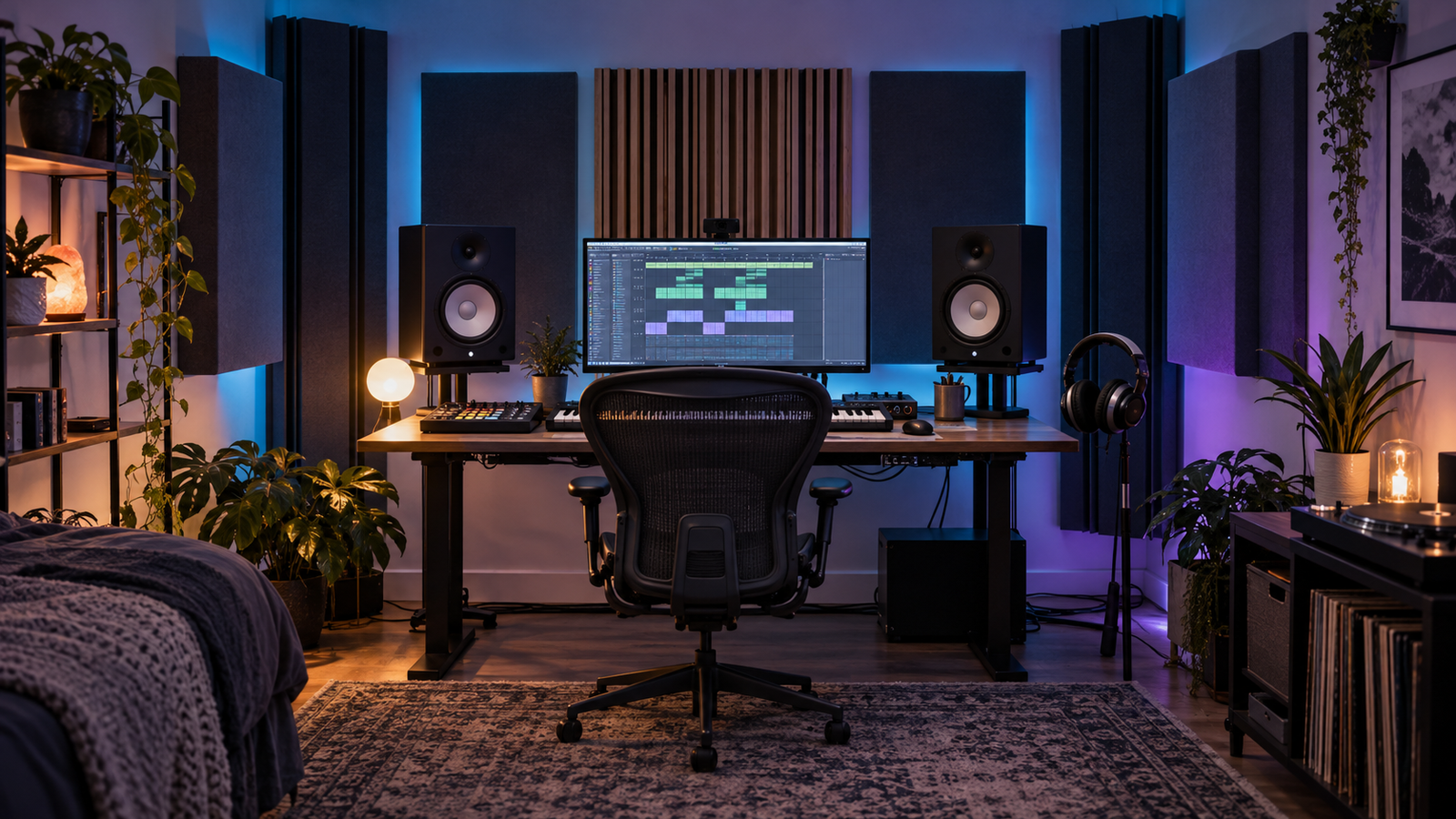
Studio headphones can reveal low bass, clicks, distortion, stereo detail and reverb without the room reflections that affect speakers. They are especially valuable when producing drum & bass in a small, untreated room. The best pair is the one that is sufficiently accurate, comfortable for long sessions and appropriate for either recording or mixing.
No headphone makes every decision automatically correct. Learn its tonal balance with familiar music, compare at sensible volume and check important mixes on more than one playback system.
Closed-back headphones
Closed-back cups reduce sound leaking out and provide some isolation from the room. This makes them useful when recording vocals or instruments because less click-track or backing audio reaches the microphone. They also suit shared spaces and late-night production.
The sealed cup can produce stronger perceived bass and internal resonances. Stereo space may feel narrower or less natural than on a good open-back pair. That does not make closed headphones inaccurate; it means their construction involves different compromises.
Open-back headphones
Open-back cups allow air and sound to pass through the rear of the driver. They often produce a more spacious presentation and can make panning, depth and midrange balance easier to judge. Heat and pressure may also feel lower during long sessions.
They leak sound in both directions. People nearby will hear the music, and outside noise reaches you. They are unsuitable beside an open microphone and less practical in noisy rooms or on public transport.
Photo to add: Your closed-back and open-back headphones side by side, with arrows showing the sealed cup and ventilated rear grille.
What matters for DnB
- Low-frequency extension: the sub should be audible without an exaggerated one-note hump.
- Midrange clarity: bass harmonics, snare body and vocals must be easy to separate.
- Controlled treble: enough detail for hats and clipping without painful brightness.
- Transient definition: kick and snare shapes should remain distinct.
- Comfort: clamp, pad depth, heat and weight matter during long sessions.
- Repeatability: replaceable pads and a durable cable extend useful life.
Impedance, sensitivity and amplifier power
Impedance, measured in ohms, is part of the electrical load presented to the headphone output. Sensitivity describes how much sound level the headphone produces for a stated electrical input. A high-impedance model is not automatically harder to drive in every case, because sensitivity also matters.
Check whether the audio interface can reach a clean, comfortable level with headroom. Do not judge suitability by turning the knob to a particular position; output designs differ. Excessive volume can damage hearing regardless of how clean the amplifier sounds.
A practical shortlist by use case
Reliable closed-back starting points include the Audio-Technica ATH-M50x, Beyerdynamic DT 770 Pro family and ADAM Audio H200. Each has a different tonal balance and fit, so auditioning is valuable. For open-back mixing, commonly considered options include the Sennheiser HD 600/650 family, Sennheiser HD 490 Pro and Beyerdynamic DT 900 Pro X. Availability and pricing change, and “best” depends on head shape, interface power and preference.
A beginner does not need several premium pairs. One dependable main headphone plus inexpensive consumer checks can be more educational than constant switching. If budget permits later, combining closed-back isolation with an open-back mixing perspective is useful.
Screenshot to add: A table containing model, construction, impedance, replaceable cable/pads, primary use and your personal listening notes. Verify specifications from the manufacturer before publishing.
Frequency response is not one number
A quoted range such as 5 Hz–40 kHz does not tell you whether the response is balanced. It may only state that some output exists at the extremes. Independent measurements can help reveal broad tendencies, but fit and ear shape change the result at the eardrum. Use charts to understand behaviour, not to select a winner from the widest printed range.
Headphone correction and virtual rooms
Correction software can reduce broad frequency-response deviations for a supported model. Virtual-room systems add speaker and room cues to reduce the unnatural inside-the-head presentation. These tools can be useful second perspectives, but they do not replace learning the untreated headphone. Always retain a direct, correction-free check.
Safe monitoring and translation
Headphones make it easy to listen louder than intended because the body does not feel room energy. Work mainly at a moderate level, take breaks and reserve brief louder checks for specific questions. If your ears ring or sound dull afterwards, the session was too loud.
- Import several well-produced reference tracks.
- Reduce them to match your working mix level.
- Learn how kick, sub, vocal and treble behave on the headphone.
- Check bass in mono and at quiet volume.
- Test the export on monitors, a small speaker and ordinary earbuds.
- Write down translation errors and compensate in future mixes.
Common mistakes
- Buying from the printed frequency range alone.
- Assuming more bass means more accurate sub.
- Using open-back headphones while recording with a microphone.
- Ignoring comfort and replacement parts.
- Mixing loudly for hours.
- Applying correction without checking the raw headphone.
- Expecting one pair to guarantee translation.
For a small untreated room, good headphones may initially provide a more dependable low-end reference than inexpensive speakers placed badly. Learn the connection and power requirements in the audio-interface guide, then compare the benefits of properly selected studio monitors.